The Sofa Is Not Always the Star: Choose a Living Area Rug Around the Room’s Real Focal Point

A living room can have a beautiful sofa and still have its visual identity somewhere else. It might be a large painting, an arched opening, a window overlooking a courtyard, a sculptural staircase, or even an unusually detailed ceiling.
Yet living area rugs are frequently selected by looking at the sofa first. The colour is matched to the upholstery, the pattern is chosen to complement the cushions, and the room is considered complete. This approach misses an important design decision. A rug occupies a large horizontal surface within the same field of vision as the room’s artwork, architecture, and furniture. Its pattern can support the most interesting feature in the room, or compete with it.
The difference comes down to understanding what deserves attention.
What Is the Actual Focal Point of Your Living Room?
Not every prominent object is a focal point. A large sofa may dominate the floor area, but an architectural opening or artwork may command more visual attention.
Three kinds of focal points are particularly relevant when selecting a handmade rug.
Architectural focal points: These are features built into the space, such as an arch, a courtyard view, a staircase, a double-height wall or a distinctive window. They are usually difficult to move or redesign, so the surrounding decor should respond to them.
Functional focal points: These relate to what the room is organised around. A television and media wall may dominate a family lounge, while a fireplace or a conversation arrangement may define another living room.
Decorative focal points: These include paintings, sculptures, statement lighting, distinctive furniture and collected objects. They introduce personal character but can also create visual competition when several are equally prominent.
A room can contain all three. The objective is not to eliminate two of them. It is to establish which one should lead and which elements should support it.
When the Architecture Already Makes a Statement, Should the Rug Be Quiet?
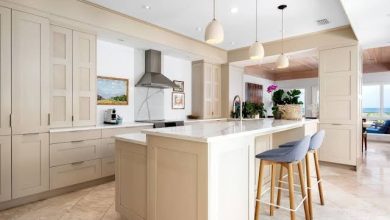
Consider a single-floor villa in Jaipur with a living room opening towards an internal courtyard or a landscaped garden. Perhaps the room also has an arch, carved detailing, a large artwork or a sculptural light installation.
The architecture already gives the eye somewhere to travel. An area rug with a large central medallion, strong borders and several contrasting colours introduces another visual destination at floor level. That may be intentional in a maximalist interior. But if the intention is to appreciate the architecture, a heavily detailed traditional rug could divide attention rather than reinforce the composition.
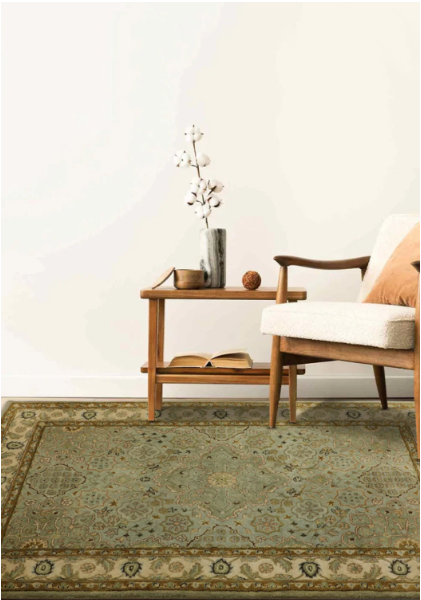
A more considered option might be a tonal pattern, an understated border or an abstract design whose colours relate to the room’s existing materials.
This is not an argument for always choosing neutral rugs in large homes. A Jaipur family bungalow documented by Architectural Digest India combines pink-and-white mosaic inlay, hand-carved marble columns, custom teak furniture, patterned upholstery, designer rugs and a chandelier. Its design works through several layers of detail rather than relying on one isolated statement.
The useful lesson is that a rug’s visual strength should be judged against the entire composition. Architectural richness does not automatically require a plain carpet, just as a plain room does not automatically need a bold one.
What If the Artwork Is the Main Attraction?
Artwork creates a particularly interesting challenge because an area rug and a painting occupy different planes but can still compete visually.
Imagine a living room with a large Pichwai painting, a richly coloured textile artwork, or a detailed traditional painting above the main seating. An area rug featuring an equally intricate central motif can introduce a second area of concentrated detail.
Both pieces may be beautiful individually. Together, they may leave the room without a clear visual hierarchy.
There are several ways to resolve this:
- Let the artwork lead: Choose a handmade rug with a restrained pattern, subtle texture or a limited colour range.
- Create a colour connection: Pick one secondary shade from the artwork and introduce it into the rug. Repeating the entire artwork palette is unnecessary.
- Use a different pattern language: A painterly artwork can sit comfortably with a structured geometric rug, provided their colours and visual intensity are considered together.
- Pay attention to scale: A dense, intricate artwork may need a more open rug pattern. A large, relatively simple artwork can accommodate a rug with greater detail.
The aim is not to match the handmade rug to the painting. It is to prevent both from demanding the same degree of attention.
In a Mumbai 2BHK, the Television May Be the Functional Focal Point
Consider a compact Mumbai 2BHK where the living room has a media wall, a balcony opening and a relatively restrained seating arrangement. The television may determine where the sofa faces, but that does not mean the rug should imitate the media wall or become another screen-like centre of attention.
A large, high-contrast medallion can pull the eye downwards every time someone enters the room. If the media wall already has textured panels, display niches or decorative lighting, the combined effect may become unnecessarily busy. A better direction could be a design with a softer overall pattern and one or two colours that connect with the upholstery or existing artwork.
There is another detail worth considering: what is visible from the entrance? In a compact home, the first sightline may include the television, a balcony view, and the area rug simultaneously. The rug should contribute to that first impression without competing with every element in it.
This is an illustrative Mumbai apartment scenario, not a claim that all 2BHK homes follow the same arrangement. The important distinction is between a room’s functional centre and its visual centre. They can be different.
Can a Rug Become the Focal Point Instead?
Certainly. Sometimes the room has no strong architectural feature or significant artwork. In that situation, the rug can provide the main visual statement. A large abstract design, an expressive traditional motif or an unusual combination of colours can give an otherwise restrained living room a distinct identity.
But a statement handmade rug needs enough visual space around it. If the sofa upholstery is heavily patterned, the curtains are elaborate, and the walls are filled with artwork, adding another prominent design may create competition rather than character.
This is where the difference between an all-over pattern and a border-led design becomes useful. An all-over pattern distributes visual activity across the rug. A pronounced border gives the composition a defined edge, while a central medallion concentrates attention in one area.
These are not simply style preferences. They determine where the eye is drawn when someone looks across the room.
Three Questions to Ask Before Selecting a Living Area Rug
Before settling on a design, look at the room from its entrance and answer three questions:
- What do I notice first?
Is it the artwork, the architecture, the television wall, the window, or the seating? Identify the feature that should lead the room’s visual composition.
- Is another element already carrying a strong pattern?
Look beyond the sofa. Consider wall art, upholstery, curtains, decorative screens, and lighting. A rug should introduce a different level of detail when the room already has several competing patterns.
- Should the rug lead or support?
If the room needs a statement, choose a design with a clear visual identity. If an architectural feature or artwork already commands attention, select a rug that strengthens the overall composition without trying to replace it.
Choose the Rug for the Room, Not Just the Sofa
A living area rug is not required to be the loudest object in the room. Nor does it need to disappear into the furniture palette. Its role depends on what the room already has. An expressive modern rug can give a restrained interior its identity, while a quieter design can allow an architectural feature or meaningful artwork to remain the centre of attention.
That distinction makes the selection process more useful than simply matching colours to upholstery. The right design should make the entire composition work, not compete with its best feature.